
Budget graphics for media, not gaming
THE ATI RADEON HD 4550 OFFERS superb video playback, multiple-monitor support, and usable-if-unimpressive 3D performance at an entry-level price. This compact card is a perfect addition to a home theater PC, particularly if you want to play HD video, but garners should considet the next card up in ATI's lineup.
The compact HD 4550 draws all its power from the PCI Express (PCIe) x16 slot it plugs into, making it a good choice for PCs with small power supplies.The card is passively cooled and completely silent, using a large metal heat sink instead of a fan.
The card we tested featured a dual-link DVI connector as well as both HDMI and DisplayPort outputs.There's onboard eight- channel sound when using the HDMI output, which is more convenient than Nvidia's HDMI-equipped cards, which require you to run an audio cable to your motherboard.
Along with 512MB of DDR3 RAM, the 4550 has DirectX 10.1 3D support and the excellent Unified Video Decoder (UVD) 2, which accelerates decoding of both DVD and high-definition or Blu-ray content. This takes the decoding load off the computer's processor, allowing smooth playback of video content on inexpensive, midrange computers, even at 1080p resolution. Both HD video and upscaled DVD content played back flawlessly, with vibrant color and no visual artifacts, on our 1.8C11z Core 2 Duo test system.
The 4550's excellent video- playback support and silent operation make it an outstanding choice for use with a home theater PC. If you spend any time gaming, however, you'd be far better served by the Radeon HD 4670, which offers more than double the 3D performance—at half the cost of a single game.
—Denny Atkin
ati.amd.com
December 30, 2008
ATI Radeon HD 4550


December 06, 2008
BFG GeForce 9600 GT OCX 512MB PCIe 2.0

Check around a little, and you'll understand why both BFG's 9600 GT OCX and 8800 GT OCX (November 2008 CPU, page 28) have garnered good reputations in the enthusiast community based on performance and value. As with the 8800 GT OCX, the midrange 9600 GT OCX uses BFG's nonreference ThermoIntelligence cooling design. The approach consits of an aluminium heatpipe, finned fansink, chrome-nickel plating, and green LED lighting emitting through clear fan blades. The card's memory and voltage regulators also get the heatsink treatment. BFG claims the setup lets the 9600 GT OCX run up to 18 degrees Celcius cooler than a stock card.
BFG ships the 9600 GT OCX running at factory "highest stable" overclocks of 725MHz vs. 650MHz core, 1,850Mhz vs. 1,800MHz memory. Not shabby considering the card was hovering around $150 online at press time. You will need two slots to accommodate the custom cooling.
Compared to a stock-cooled Gigabyte 9600 GT, the overclocked BFG 9600 GT OCX expectedly pulled away in every bench, although not by leaps and bounds in two gaming benches and in 3DMark Vantage GPU scores. Compared to a stock-cooled Gigabyte 9800 GT I found similarly priced online, the BFG card was right on pace across the board. If you're looking for a shot in performance at a fair price, BFG's 9600 GT OCX is a "cool" option.
by Blaine Flamig
www.bfgtech.com
Computer Power User January 2009
ATI Radeon HD 4670

List this one in the "Didn't see that one coming" category. The ATI Radeon HD 4670 is a surprisingly good graphics card for the $79 price tag. I tested the vanilla version of the 4670 and was pleased to discover that it produced decent frames rates in gaming benchmarks. In 3DMark Vantage, it cranked out an impressive E7054.
The claim by ATi that this is a card that offers the same performance as some higher-end cards is perhaps stretching it a bit, however (props to the PR folks for a nice efforts, though). Sure, it can handle DX10 gaming, so long as the game's quality settings and resolution are set low.
As far as ports go, our unit had one DVI port and two DisplayPort outputs.
For serious gamers, the 4670 isn't going to cut it. But if you grab a pair of them to use in a CrossFire configuration, you may find that you can squeeze out some high-quality gaming performance.
by Seth Colaner
ati.amd.com

Computer Power User January 2009
AMD ATI Radeon HD 4550

The ATI Radeon HD 4550 is being billed as AMD's low-cost option and the competition for the Nvidia GeForce 9400 GT. Price-wise, both cards are coparable, which should make for an interesting battle as the two battle at the bottom rung of the graphics ladder.
Entry-level graphics cards rarely blow us away with their benchmark scores, so we weren't expecting above-average performance from the HD 4550 at high-quality settings. We were still a bit surprised, however, that it produced less-than-playable frame rates in Compay of Heroes, World in Conflict, and Crysis at medium-quality. What it can do, though, the 4550 does in cool silence, thanks to its passive cooling.
Overall, the Radeon HD 4550 isn't a bad card, so long as your expectations are in line with its price tag. But when you consider the ongoing improvement of integrated graphics, it become apparent that IGP could easily catch up to this card in no time. In other words, the 4550 needs to work a little harder to impress us.
by Joanna Safford

Computer Power User January 2009
December 05, 2008
PowerColor PCS+ HD 4870 1GB GDDR5

When the Radeon HD 4870 first hit the scene, it was universally praised as a great performer and excellent value. But one major concern among many users of Radeon HD 4870 cards was heat. Although outfitted with a beefy two-slot cooler, reference Radeon HD 4870 cards ran quite hot.
By tweaking fan profiles, manufacturers (and users) were able to address the 4870's heat output somewhat, but PowerColor took a different approach and simply replaced AMD's reference cooler. The PowerColor PCS+ HD 4870 1GB GDDR5 features a custom cooler with a large center-mounted fan, four heatpipes and a densely packed array of aluminium heatsink fins. The cooler's design looks relatively simple and elegant, and it's far lighter than AMD's reference cooler.
During testing, I actually found the cooler performed better than PowerCOlor's claims. Whereas our reference Radeon HD 4870 idled at around 75 degrees Celcius and peaked at about 90C, PowerColor's offering with the PCS+ cooler ran at roughly 60C and 80C under idle and load conditions, respectively. And PowerColor's card also had a higher-clocked GPU and a 1GB frame buffer.
One issue with the PCS+ cooler is noise, however, At idle, this card is a bit louder than reference cards. Under load, noise output is about the same. All inall, the PowerColor PCS+ HD 4870 1GB is an attractive product.
by Marco Chiappetta
Computer Power User January 2009
MSI R4870X2-T2D2G-OC
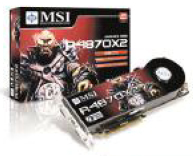
Factory-overclocked Radeon HD 4870 X2 cards have begun hitting retail shelves recently, with MSI's R4870X2-T2D2G-OC being one of the first. MSI's overclocked spin on the Radeon HD4870 X2 features 2GB of onboard GDDR5, 1 GB per GPU, and a pair of RV770 GPUs.
Unlike reference 4870 X2s, MSI gooses the frequency on each of the card's GPUs to a speedy 780MHz, 30MHz higher than stock. The extra 30MHz give MSI's offering a slight boost in performance, where its 1,600 stream processor can crunch through complex shaders quicker than lower-clocked 4870 X2 cards. MSI doesn't tweak the memory frequency though.
Other than its slightly higher GPU clock, the MSI R4870X2-T2D2G-OC differs from other Radeon HD 4870 X2 cards only by the custom decal affixed to its fan shroud. The actual fan, cooler, PCB, and outputs match AMD's reference design.
As you probably expect, given the Radeon HD 4870 X2's reputation, the higher-clocked MSI cards performed very well in the benchmarks. Except for one instance where the test system was CPU-bound (3DMark06), it outperformed a reference Radeon HD 4870X2 in every test. Considering the card's performance and the fact that MSi doesn't charge a premium for the factory overclock, I can't help but like the R4870X2-T2D2G-OC. If its accessory bundle was a little better and included a current game, this card would be tough to beat.
by Marco Chiappetta
R4870X2-T2D2G-OC
$549
MSI
www.msicomputer.com
Computer Power User January 2009


Asus EAH4870X2

The best single-card graphics performance available
THE ASUS EAH4970X2 is a powerhouse video card that uses ATI's new Radeon HD 4870 X2 design, which places two top-of-the-line 4870 GPU chips on a single board, backed by a whopping 2GB of video memory. The 4870 X2 puts ATI back in competition at the top end of the 3D-gaming market in terms of both performance and price.
The EAH4870X2 is functionally equivalent to two HD 4870 cards running in CrossFireX mode, but on a single card. Each GPU is backed by 1GB of dedicated GDDR5 memory, and an onboard PCI 2.0 bridge chip allows the two subsystems to communicate. This means you don't need a CrossFireX-compatible motherboard, but you do need a 600-watt power supply, both six-pin and eight-pin PCI Express power cables, and room for 10.5-inch-long board that blocks an adjacent slot. The EAH4870X2 is also much louder than the single-GPU HD 4870 because of its fan.
The board includes a pair of dual-link DVI connectors, an HDMI adapter with onboard audio, and an analog component-video/S-Video output. Unlike Nvidia's dual-GPU GeForce cards, you can use dual monitors with the EAH4870X2 without having to disable the second GPU.

The EAH4870X2 delivered excellent image quality in our video-playback tests, and for gamin proved the fstest single video card we've tested to date. At 2,560x1,600 resolution, the EAH4870X2 turned in 41 frames per second (fps) in World in Conflict, 54.7fps in Company of Heroes, and 116fps in F.E.A.R. Dual-GPU solutions like the EAH4870X2 require the drivers to support the game you're playing with a CrossFireX profile, though not all titles benefit from the second GPU.-Denny Atkin
Computer Shopper November 2008
usa.asus.com


 Posts
Posts

